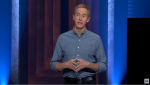
In Kansas, where cattle outnumber people and the beef industry generates billions in economic activity, the Democratic nominee for U.S. Senate once stood in the pulpit and treated raising and eating that livestock as a matter for repentance.
UNHINGED: Kansas Democrat Senate candidate Adam Hamilton told his congregation to repent for raising cattle and eating beef.
— Steve Guest (@SteveGuest) September 28, 2026
Hamilton said, "Some of the things that we grow because we like to eat them, like cattle, end up producing more carbon dioxide than other crops that we… pic.twitter.com/Ac1BLFI7WX
Adam Hamilton, founding pastor of the United Methodist Church of the Resurrection in Leawood, the largest congregation in the denomination, delivered a January 2020 sermon titled “What would Jesus say about climate change?” In it he told worshippers that “some of the things that we grow because we like to eat them, like cattle, end up producing more carbon dioxide than other crops that we could grow or other forms of food that we could have.” He framed the response in explicitly religious terms: repentance means seeing the issue differently, a changed heart, and changed behavior. He urged reduced fossil-fuel use and suggested dietary shifts so that “the things that you eat are requiring less production that creates methane and carbon dioxide.” The remarks have resurfaced as Hamilton challenges Republican Sen. Roger Marshall.
The framing is revealing. Hamilton did not merely note agricultural emissions data or discuss trade-offs in land use and protein production. He cast ordinary economic activity central to his state, and the personal choice to eat beef, as a moral failing that required congregational repentance. Kansas ranks among the top beef-producing states; the industry supports tens of thousands of jobs. A pastor whose church sits in the Kansas City suburbs chose to locate sin in the carbon intensity of cattle rather than, for example, in the ordinary vices or doctrinal disputes that once occupied Methodist preaching. The sermon mixed Scripture with a presentation on greenhouse gases, subordinating the former to the policy priorities of the latter.
This is consistent with the trajectory of the United Methodist Church itself. The denomination has spent years navigating internal conflict over sexuality, marriage, and the authority of traditional teaching, culminating in large-scale disaffiliations by more conservative congregations. Hamilton’s Church of the Resurrection remained within the continuing UMC and has been identified with its more progressive wing. When a leading pastor in that tradition runs for Senate in a red state and deploys the language of repentance against a signature local industry, voters are entitled to ask whether the theology on offer is primarily Christian or primarily an application of contemporary environmental priorities to the pulpit.
Hamilton is not an isolated case. In Texas, James Talarico, the Democratic nominee for Senate, has built a national profile by campaigning explicitly as a progressive Christian. A Presbyterian seminarian who attends St. Andrew’s Presbyterian Church (PCUSA) in Austin and cites his Baptist-preacher grandfather, Talarico regularly interprets policy disputes, on economics, immigration, and social issues, through a hermeneutic delivered by Obama himself. Reporting has noted his description of God as “being itself” rather than a being, and his rejection of exclusive claims about Christ in favor of multiple pathways to the sacred. Like Hamilton, he presents faith as a warrant for left-leaning politics rather than a constraint on them. Multiple Democratic candidates who are pastors, former clergy, or seminarians have appeared on ballots this cycle, including in Iowa. Party strategists appear to have concluded that white mainline or progressive Protestant candidates can neutralize Republican advantages on religion in certain states. The approach treats the vocabulary of sin, repentance, and neighbor-love as portable rhetoric that can be attached to climate targets, expanded social programs, or immigration policy. Whether the underlying theology retains any independent content, distinct from the platform it is asked to bless, is a secondary concern.
Hamilton’s campaign has responded to the sermon clips by noting that Marshall has also discussed methane from cattle and by releasing a video of the candidate grilling steak. Those replies do not erase the original language. A candidate who once told his congregation that their preference for beef contributed to a problem requiring repentance is now asking the same state to send him to the Senate. The United Methodist pulpit supplied the framing; the Democratic primary supplied the nomination.