

One of the false dichotomies to persist for the past several decades is the divide between Egalitarianism and Complementarianism, where especially the latter will often contend to articulate paper differences between men and women while attempting to get as close to the artificial line without actually crossing it. In practice, this often looks like a church declaring a belief in only male ordination but functionally allowing women to operate in positions of power, whether they be deacons, shepherdesses, or even female speakers on Mother’s Day. Additionally, they might be fine with women teaching other women, which most major female teachers do not exclusively teach to women.
The current standard of complementarianism is that the Scriptures only require that the “Lead/Senior” pastor be male, and a woman can operate under his authority. This is the current theology of the Southern Baptist Convention and is promulgated by The Gospel Coalition. For years, The Gospel Coalition has elevated women in ministry and advocates this on the local level, as was seen with Jen Wilkin promoting a women’s advocate in the local church.
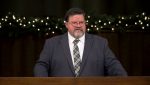
In their TGC Women’s conference, they had a breakout session where Mike Kruger, President and Samuel C. Patterson Professor of New Testament and Early Christianity at Reformed Theological Seminary, spoke on the subject of women in ministry. While most of his speech was a survey of women in the early church, the subversion is front-loaded in how he frames the issue of women in ministry. The type of ministry he speaks to at the beginning is not evangelism, succor, hospitality, childrearing, or roles typically associated with women in ministry, but rather more directional leadership in the local church, which is wholly absent in the rest of the speech where he surveys the notoriety of women in the ancient church. Thus, the latest subversion is the framing by which the audience is supposed to interpret the rest of his speech.
The church has not just people in it, but they have spiritual fathers and spiritual mothers and spiritual brothers and spiritual sisters and spiritual daughters and spiritual sons all working together for Kingdom and goals. And just like a human family needs both fathers and mothers, the church family needs both fathers and mothers.
The concept of a spiritual mother compared to that of a father is rather novel and egalitarian on the surface. America has Founding Fathers, not mothers. They are called the Church/Apostolic Fathers, not the “Church Mothers.” The reason great men are referred to as fathers is because of their leadership roles. All earthly authority is an extension of the 5th commandment. The king is as a common father to his nation, a master is a father over his servants, and a pastor over his flock. Thus, the label father is appropriate.
When you start a church, you start with pastors. No one’s denying that. But as a church grows and has the financial ability, I always encourage my students hire women on staff. They’re bringing different perspectives, different voices, different gifts. They see things you won’t see. They balance out the family of God. You can’t have just spiritual fathers. You need spiritual mothers. It’s just practically. True that men and women just see things in different ways.
This is what is called Standpoint Epistemology, whereby one requires a balance of differing demographics or perspectives in order to arrive at the truth. Standpoint Epistemology was notoriously employed by Critical Race Theorists who claim that “black voices” are required to fully understand Scripture because blacks bring a unique perspective to the table. Feminists often employ this tactic in their arguments, citing that “50%” of the church is women, but this is irrelevant to the leadership requirements for the Church or the ability of the Church to arrive at correct doctrine. By extension, this can apply to various other races, women, or even sodomites. Where Standpoint Epistemology falls flat is that Christianity did not need women, Asians, or blacks to understand Scripture or arrive at the core doctrines, like the Trinity. At its logical conclusion, every Church doctrine and confession can be relitigated under Standpoint Epistemology because the Nicean Council lacked diversity.
Kruger is advocating that churches practice DEI for women, who are already the number one beneficiaries of DEI. There are only two offices the Church requires: pastors and deacons—both of which are exclusively male. Scripture does not say the church needs a “spiritual mother” when the ordination is exclusive to men. Moreover, the Old Testament Church did not have “spiritual mothers” or women in leadership.
Here’s another implication I tell my students, when you go and you preach, you need to have a sermon feedback committee. How are you reaching the church? How’s your preaching resonating with the people? And half that committee, of course, need to be composed of women. They hear things differently. They take sermons differently. They see scripture differently.
Beyond the elders and deacons ensuring there were no heresies preached, the notion of a “feedback committee” is functionally giving authority over the church to women in direct violation of 1 Timothy 2:12. As a seminary professor, Kruger is advocating sinful polity because letting women dictate the direction of the preaching is usurping authority over the pastor. Hardly can it be expected that “Sinners in the Hands of an Angry God” would be the result of such a feedback committee. Catering the message to the crowds is what undergirds the seeker-sensitive church, which is notorious for ear-tickling, crowd-pleasing sermons but devoid of good teaching.
Women are often averse to difficult truths, especially as they pertain to their duties, and more susceptible to manipulation (1 Peter 3:7). The flaw of the modern evangelical church is that it caters to suburban women, whether through the worship music, theologically soft sermons, or even the lack of head coverings.
Conclusion
While The Gospel Coalition calls itself complementarian, they are really just soft egalitarians who advocate for women in leadership at the local church level in violation of Scripture. Mike Kruger speaks of women in the early church to convey that women should be grading the pastor’s sermons as their role in ministry, which is antithetical to the historic church. The purpose of biblical proscriptions is not to see how close to the line one can get without violating the standard, but to avoid it entirely. As a seminary professor, he is instructing future pastors to flirt with God’s law, which ultimately leads to breaking it.
The Gospel Coalition is advocating for a Longhoused Church where men remain the overseers on paper but are functionally subjugated to the women in their church. Improper church polity is both sinful and yields disastrous fruit, which is the legacy of The Gospel Coalition as a ministry.





One Response
This line sounds wrong
“The current standard of complementarianism is that the Scriptures only require that the “Lead/Senior” pastor be male, and a woman can operate under his authority. ”
The issue is not whether women have roles within a church the issue is whether they are qualified to be pastors.. Husband of 1 wife, a woman cannot be a husband. this isn’t rocket science people.